Terminology
continued
Seam Allowance (cont’)
Leaving more seam allowance gives the home sewer more
opportunity to adjust fit after a garment has been constructed, whereas in the industry, companies want to improve yield and therefore use less seam allowance.

Grain
The direction of the threads in a woven fabric, or the lengthwise, long warp threads.
Sloper
Basic apparel patterns without style lines or seam allowance used at the beginning of the pattern making process to create new styles. Slopers are often used repeatedly. They contain all the necessary pieces to create a new style. For example; a button down shirt would have a front and back bodice, sleeve, cuff, placket, and collar. Slopers are also called master patterns, foundational patterns, or standard patterns.
Muslin
A plain weave, unbleached cotton fabric available in a variety of
weights. It is used to perfect the fit of a pattern before the slopers,
or final patterns are created. Muslins are used for fit and are commonly torn apart or drawn on to reflect desired fit adjustments.
Notch
Symbols, or markings used on a pattern to indicate cutting lines,
joining points, hems, dart legs, CF (center front) and CB (center back), etc. There are a lot of pattern markings and this is covered in the pattern markings article. Single notches refer to the front of a pattern and a double notch refers to the back of a pattern.
Trueing
A process in double checking that all measurement’s, seams, etc. are of equal length.

Sleeve cap
The curved top section of a sleeve that when on the body fits just over the shoulder.

The area added to a pattern to between the cutting line and the
stitching line allowing for a specific amount of extra fabric. The
amount of seam allowance differs for the home sewer and the apparel industry.
Reprinted by permission - ©2019 Isn't that Sew, LLC -

Page 36
Page 35

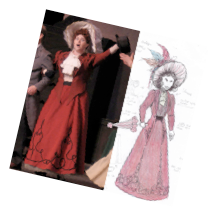

Costume Design