The shape of the foundation
Patterning
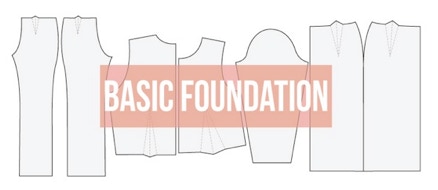
Foundation patterns use the dimensions of the body to create a series of two-dimensional straight and curved *lines. When said lines are connected and later sewn together in fabric, they will create a three-dimensional garment that is tailored to the body. To put it plainly, a series of points are plotted (from the bodies measurements) and the dots are connected to create a flat pattern.
*Examples of straight lines would be side seams, shoulder seams, and lines below the hip. Examples of curved lines would be armholes, necklines, and hip curves.
1
All about darts
1
Often times, in woven apparel, a series of “wedge” shapes are used to manipulate the fabric into a shape that will fit the three-dimensional form. These “wedge” shapes are called darts.Darts create shape in woven apparel by removing unwanted fullness at the edge of a pattern. Darts are most often used around the bust, waist, hip, shoulder, abdomen, and sometimes the elbow. Darts are not only used for tailoring, they are also used for design purposes.
The basic foundation
The basic foundation patterns start as either a paper (flat pattern making) or muslin (draping). The dimensions for creating the pattern are determined by the end use of the blocks. For example; an apparel company would use the dimensions of their fit model. If you are interested in designing and creating patterns for yourself, you would use your own set of measurements. Print this handy body measurement guide to keep track of all your important measurements.

Page 18

Page 17


Costume Design
An explanation of Fabric
The shape of the foundation
Patterning
1
Foundation patterns use the dimensions of the body to create a series of two-dimensional straight and curved *lines. When said lines are connected and later sewn together in fabric, they will create a three-dimensional garment that is tailored to the body. To put it plainly, a series of points are plotted (from the bodies measurements) and the dots are connected to create a flat pattern.
*Examples of straight lines would be side seams, shoulder seams, and lines below the hip. Examples of curved lines would be armholes, necklines, and hip curves.
1
All about darts
1
Often times, in woven apparel, a series of “wedge” shapes are used to manipulate the fabric into a shape that will fit the three-dimensional form. These “wedge” shapes are called darts.Darts create shape in woven apparel by removing unwanted fullness at the edge of a pattern. Darts are most often used around the bust, waist, hip, shoulder, abdomen, and sometimes the elbow. Darts are not only used for tailoring, they are also used for design purposes.
Types of Fabric
The basic foundation
The basic foundation patterns start as either a paper (flat pattern making) or muslin (draping). The dimensions for creating the pattern are determined by the end use of the blocks. For example; an apparel company would use the dimensions of their fit model. If you are interested in designing and creating patterns for yourself, you would use your own set of measurements. Print this handy body measurement guide to keep track of all your important measurements.
This is a video about how to buy fabric! An overview of common terminology and shopping tips. Watch and learn why fabrics are used for clothing and other projects. Reasons that might be helpful to help how to buy fabric.
Page 20
Page 19
Costume Design