Line set
Counterweight System

Line set
Counterweight System
The line set is the fundamental machine of a typical fly system.
The function of a typical line set is to fly (raise and lower) a slender beam (typically a steel pipe) known as a batten (or a bar in the UK) by hoisting it with lift lines (typically synthetic rope or steel cable). By hanging scenery, lighting, or other equipment to a batten, they in turn may also be flown. A batten is said to be "flying in" when it is being lowered toward the stage, and "flying out" when it is being raised into the fly space. Battens may be just a few feet in length or may extend from one wing (side) of the stage to the other. A batten is suspended from above by at least two lift lines, but long battens may require six or more lift lines.
In manual rigging, a line set’s lift lines support weights opposite their connections to the batten in order to balance the weight of the batten and whatever it carries. The lift lines are reeved through a series of pulleys, known as blocks, that are mounted above the stage to fly loft structure. An operating line (a.k.a. hand line or purchase line) allows riggers on the fly crew to raise and lower the batten.
Automated rigging sometimes uses weights to help balance line set loads in a manner similar to manual counterweight rigging. Otherwise it relies solely on the motor power of an electric hoist to fly a line set.
Together, a series of parallel line sets regularly spaced up and down stage, commonly at 6 in (150 mm), 8 in (200 mm), or 9 in (230 mm) centers, comprise the bulk of most fly systems. Theatrical rigging systems are made up of hemp, counterweight and/or automated line sets able to serve various functions.
Line set functions
Line sets are typically general purpose in function, meaning they can perform any number of functions which vary depending upon the requirements of a particular theatre production. For example, a general purpose line set can usually be quickly transformed into a drapery or scenery line set, but converting a general purpose line set into an electrical line set is more involved.
When a line set has a predetermined, relatively permanent, function it is known as a dedicated line set. Line set functions include:
Drapery and track line set
Line sets often suspend theater drapes and stage curtains such as travelers, teasers (a.k.a. borders), legs, cycs, scrims and tabs, as well as associated tracks, in order to mask and frame the stage and provide backdrops. Line sets are sometimes dedicated to particular draperies, such as the main (grand) curtain and main border (valance) that mask the proscenium opening, but drapery locations can often vary.
Scenery line set
In many stage productions, theatrical scenery is mounted to line sets in order to be flown in and out so as to quickly change set pieces during the course of a performance. For example, painted soft and hard flats (e.g., muslin drops) and are commonly used to depict settings. Also, three-dimensional sets (e.g., box sets) may be flown.
Electric line set flown in
Electrical line set
Electrical line sets, commonly called electrics, are used to suspend and control lighting instruments and, in many cases, microphones and special effects equipment as well. Electrics may be temporarily "wired" with drop boxes (electrical boxes with outlets) or multicable fanouts dropped from the grid or draped from a fly gallery, or permanently wired with connector strips (specialized electrical raceways).[2]
There are normally at least three electrical line sets provided above the stage, with one just upstage of the proscenium wall, one mid-stage, and one just downstage of the cyclorama. Additional electrics are typically desirable.
Permanently wired electrical line sets are known as dedicated electrics, fixed electrics or house electrics. In addition to providing dimmed and switched outlets for lighting fixtures, connector strips may provide low-voltage controls (e.g., via DMX512 and Ethernet taps), for moving lights and effects, as well as microphone jacks. Power is fed to fixed electrics from terminal boxes at the grid deck via multicable. Single and double-purchase cable cradles mounted to lift lines can be used to drape the multicable, prolonging its lifespan and reducing the likelihood of conflict with adjacent line sets or lighting instruments. Pantographs are also used to drape the multicable feeding dedicated electric line sets.
Dedicated electrics typically employ truss battens (pipe over pipe) to facilitate cable snaking and to maximize lighting positions. In large professional theatres, such as the Philadelphia Academy of Music, an electric may take the form of a flying bridge (catwalk) that provides a walkable platform for electrician access to fixtures and effects. Flying bridges may also be used for followspot positions.
Shell cloud line sets flown out
Orchestra enclosure line set
It is not uncommon for the ceiling panels, clouds, of an orchestra shell to be flown. Larger, multi-use theaters that must frequently convert the stage from a drama theatre to a concert hall often make use of the fly system in this way. Before being flown the cloud is pivoted to a vertical orientation to minimize the space it requires for storage in the fly loft.
Focus chair line set
A less common use for the fly system is the use of a focus chair system. This is a system where a small chair with fall protection equipment is suspended from a track that runs the length of a batten to which it is mounted. An electrician sits on the chair, and is flown out to the height of the electrics, to focus lighting instruments.
Flying rig
Flying rigs are used to fly scenery or performers in a more elaborate fashion than typical line sets. A flying rig typically allows horizontal as well as vertical movement by paying out individual lift lines to varying lengths and/or through the use of tracks. Flying rigs usually involve specialized equipment and techniques operated by a relatively experienced crew. Peter Foy is known for his innovations in manual flying rigs, especially those used in theatrical productions of Peter Pan. Automated flying rigs, which synchronize multiple point hoists, are becoming more common as motor control systems become safer and more sophisticated.
Fire Safety curtain
A permanently installed fire curtain line set, though not used for productions, is a typical element of a theatrical rigging system installation. Building and fire codes typically require that either a fire curtain or water deluge system be installed to separate an audience from the stage in the event of a fire.
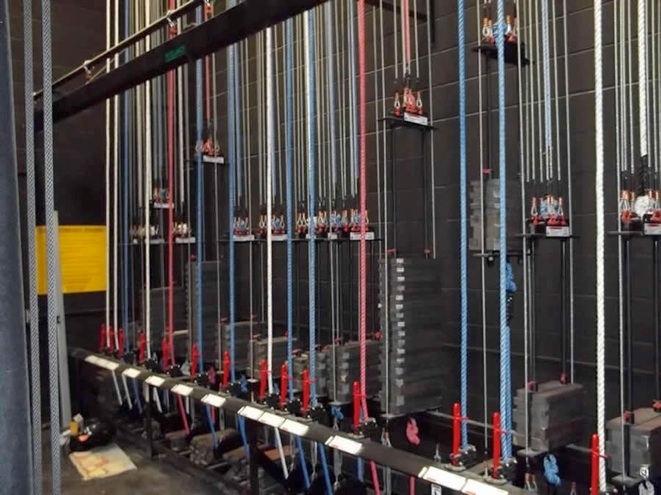
Line Set


https://en.wikipedia.org/wiki/Fly_system#Line_set_functions