Flats

1. What is stock scenery?
Stock scenery is standardized rectangular flats (including door, window and fireplace flats) which can be easily assembled into a set. Because they are standardized, they can be quickly repainted and used in another production. The use of stock scenery can reduce the set budget for a show to the cost of paint.
2. What are the standard heights of the flats in a stock set?
12, 14, and 16 feet. Units over 16' in height are difficult to handle. Probably the most commonly used set height is 12 feet.
3. What are the standard widths?
1, 2, 3, 4, 5, and 6 feet. Walls wider than 6 feet are assembled from two or more flats.
4. What is the standard width of a stock door, window, or fireplace flat?
5 or 6 feet.
5. What is the typical size of the "hole" in a door flat?
3' x 7 foot. The "hole" is normally centered in the flat.
A window flat?
3' x 6 foot. The bottom of the window is usually 2' above the stage floor.
A fireplace flat?
3' x 3 foot.
6. What is a backing flat?
Two or more short flats representing the adjoining room, placed behind a door or arch unit. Backing flats are normally 8 feet tall.
7. How does a Hollywood Flat differ from a theatrical flat?
A Hollywood Flat (also known as a hard flat) is covered with 1/4 plywood or Luan (also known as 1/4" Mahagony Underlayment) instead of muslin.
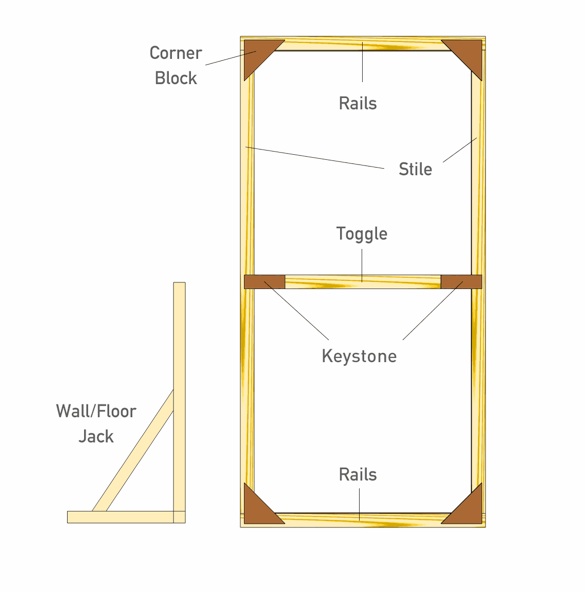
Theatre flats, or scenery flats, are placed at the back and sides of a stage and painted to provide a background for the performance. Flats come in two styles. A Broadway flat is made by stretching canvas over a frame to create a one-dimensional background. A Hollywood flat is made by turning the boards on their edges to make a three-dimensional, boxlike frame. Each type is uniform in size and design so they can be stacked together and stored in a small space. You can build theatre flats from lumber, plywood and cloth.

Scenic Elements: Drops, Flats and Platforms - Northern State University
www3.northern.edu/wild/ScDes/sdch09.htm
How to build a Broadway Flat